Links: Amazon BN
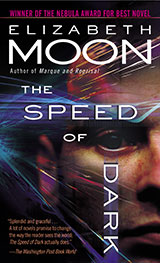
Overview from the author's website: "Lou is a high-functioning autistic adult who has made a good life for himself and is, he thinks, content. But a new manager in the pharmaceutical firm for which he works decides to put pressure on the unit that employs autistic persons. Lou is pressured to undergo an experimental treatment that might "cure" the autism he doesn't think needs curing, or risk losing his job--and certainly the accommodations the company has put in place for its autistic employees."
This book had me hooked by page 2. The author did such a wonderful job of bringing me, the reader, into the head of Lou and letting me see the world through his eyes. The majority of the novel is written in the first-person, present tense, which in this book helps me better understand Lou's point of view. Lou's perspective is not that of a normal protagonist, as it is highly affected by his autism. I can't personally vouch for the accuracy of Moon's portrayal of the autistic perception, but in her acknowledgements she recognizes the help of several autistic individuals, including her own teenage child.
I think part of this book's draw is that it gives readers a chance to see their ordinary world from a fresh perspective. The setting is the near future, around 2040. No drastic changes have taken place, so it's a very relatable setting, if slightly more advanced technologically. Some of the things we take for granted or do without thinking completely baffle Lou, particularly social cues. For example, Lou is constantly bothered by the fact that "normal" people refuse to say what they really mean, choosing rather to couch their real desires in complex phrasing that he has taken great pains to learn how to decipher. Body language and facial expressions are also mysteries which lead Lou to almost believe normal people can read each others' minds.
The title comes from Lou's concern over how one might measure the speed of dark. Dark always outruns light, so its speed must be faster than that of light. He considers the generally accepted fact that dark is merely the absence of light, but reasons dark itself must have substance. He compares light to knowledge, thereby equating dark with ignorance. It is true that some ignorance is merely the absence of knowledge, but occasionally one encounters willful ignorance, meaning it has substance because it refuses to yield to light. Lou concludes there must also be substantial dark, then, and that substance must have a speed, which is faster than the speed of light.
Many of the reviews for this book claimed reading it would change the way I see the world. To some extent, they were correct. More than anything, I have learned to better appreciate those labeled as "disabled," either mentally or physically, by society. They are often capable of much more than we give them credit for, and if we take the time to learn from them, I think we would frequently be surprised. We all can benefit from a little mind stretching every now and then, and this book delivers that.

No comments:
Post a Comment