Links: Amazon BN
As promised, I'm going back to review some of my favorite series. Near the top of that list is the Dresden Files series. In this review, I will do my best to avoid any spoilers while still providing a helpful summary of the setting.
Harry Dresden is a wizard, living in modern-day Chicago. He's in the phone book under "Wizards". Not surprisingly, his is the only entry. Most wizards prefer to avoid advertising their talents to the world at large, but Harry has to make a living somehow, and this is his chosen profession. He is generally hired as a private investigator by individuals who feel his talents (if they're real) may prove useful in their case. In addition, Harry is an official consultant to Chicago PD Special Investigations section. SI is often handed the unexplainable supernatural cases, and Karrin Murphy, the head of SI, has made the intelligent choice to retain the services of Chicago's only professional wizard to help her take care of the bad guys.
Most of the books are episodic in nature, with Harry being called on to investigate some strange occurrence or another. There is an underlying common thread in the plot, however, and that commonality is revealed more and more as the series progresses.
All of the Dresden books are told in the first person, from Harry's point of view. This allows the reader to become very well acquainted with Harry's opinions, as well as his uniquely dry sense of humor which is part of the series's charm.
Another characteristic of the series I quite admire is Jim Butcher's completeness and attention to detail. MANY facets of the supernatural are presented, including, but not limited to, faeries, vampires, werewolves, angels, demons, and zombies. Harry often finds himself, with his friends and allies, involved in supernatural power plays and schemes whose intricacy speak to the amount of forethought Butcher puts into each story he concocts.
Particularly interesting to me is Butcher's treatment of faith. It is clearly a power separate from magic, and it has great influence in the world. Harry himself isn't religious, but he knows from firsthand experience that the Almighty exists and has agents in the world. The devil exists, as well, and has his own minions with which Harry must contend on occasion.
There are currently 14 books in the Dresden Files series, along with a number of short stories. According to Jim Butcher's website, we can expect approximately ten more books before the series is finished. For those interested, the first book is called Storm Front, and links for purchasing may be found at the top of this post.
Welcome to Ex Libris Nathani. If this is your first time visiting the site, please read the introduction
Thursday, April 4, 2013
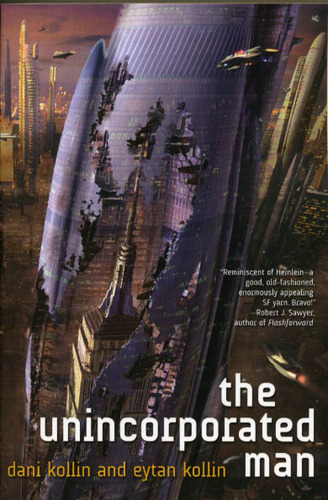
The Unincorporated Man, by Dani and Eytan Kollin
Links: Amazon BN
This book and its sequels make up what is currently my favorite series that I've ever read. Please keep that in mind as I review the book. I hope I don't oversell it.
The setting of The Unincorporated Man is approximately 300 years in the future. Humanity has recovered from a devastating societal collapse, and the mechanism that has driven its recovery is the concept of personal incorporation. The idea is this: Each person is incorporated at birth with one hundred thousand shares of stock. These shares are initially held by the individual, with two exceptions: First, instead of taxation, the government holds 5% of each person's shares. Second, the individuals parents are awarded a 25% in each of their children, both as an incentive and as a reward for their efforts in raising the child. Siblings are also awarded stakes in each other. When a child enters school, he doesn't pay tuition; instead, the school takes some of the individual's shares as an investment in his future. Generally, by the time an individual has completed his education and entered the workforce, he retains less than 50% of his own shares, making him a minority shareholder. His goal, then, as a working member of society is to earn enough money to reacquire a majority share in himself, which status allows him greater freedom to choose his path in life or even retire.
There are many other exciting features of this futuristic civilization. Nanotechnology has progressed to the point that aging has effectively been eliminated. A person can choose to look as old or as young as he chooses. Space exploration has led to the colonization of the moon, Mars, the Asteroid Belt, and the moons of the outer planets. There are other advancements, as well, but I'll let you discover those for yourself.
The title character of this book is Justin Cord. Justin was a billionaire industrialist from the near future who developed terminal cancer. Instead of giving up and allowing himself to die, Justin chose to have himself cryogenically frozen and stored underground until medical technology had progressed enough to cure him. Justin awakes in this brave new world after three centuries of hibernation, and must learn to cope with this unfamiliar society. He is the Unincorporated Man, owned by no one, and he intends to remain that way.
The authors of this book, Dani and Eytan Kollin, are wonderfully descriptive in their writing, and this above all else is what makes the story so engaging. As I read, I feel like I come to know these characters, and their struggles are very real to me as I'm sucked into the plot. I freely admit this book has brought me to tears on multiple occasions due to the power and quality of the writing. I recommend this book without reservation to any and all readers.
This book and its sequels make up what is currently my favorite series that I've ever read. Please keep that in mind as I review the book. I hope I don't oversell it.
The setting of The Unincorporated Man is approximately 300 years in the future. Humanity has recovered from a devastating societal collapse, and the mechanism that has driven its recovery is the concept of personal incorporation. The idea is this: Each person is incorporated at birth with one hundred thousand shares of stock. These shares are initially held by the individual, with two exceptions: First, instead of taxation, the government holds 5% of each person's shares. Second, the individuals parents are awarded a 25% in each of their children, both as an incentive and as a reward for their efforts in raising the child. Siblings are also awarded stakes in each other. When a child enters school, he doesn't pay tuition; instead, the school takes some of the individual's shares as an investment in his future. Generally, by the time an individual has completed his education and entered the workforce, he retains less than 50% of his own shares, making him a minority shareholder. His goal, then, as a working member of society is to earn enough money to reacquire a majority share in himself, which status allows him greater freedom to choose his path in life or even retire.
There are many other exciting features of this futuristic civilization. Nanotechnology has progressed to the point that aging has effectively been eliminated. A person can choose to look as old or as young as he chooses. Space exploration has led to the colonization of the moon, Mars, the Asteroid Belt, and the moons of the outer planets. There are other advancements, as well, but I'll let you discover those for yourself.
The title character of this book is Justin Cord. Justin was a billionaire industrialist from the near future who developed terminal cancer. Instead of giving up and allowing himself to die, Justin chose to have himself cryogenically frozen and stored underground until medical technology had progressed enough to cure him. Justin awakes in this brave new world after three centuries of hibernation, and must learn to cope with this unfamiliar society. He is the Unincorporated Man, owned by no one, and he intends to remain that way.
The authors of this book, Dani and Eytan Kollin, are wonderfully descriptive in their writing, and this above all else is what makes the story so engaging. As I read, I feel like I come to know these characters, and their struggles are very real to me as I'm sucked into the plot. I freely admit this book has brought me to tears on multiple occasions due to the power and quality of the writing. I recommend this book without reservation to any and all readers.
Thursday, March 28, 2013
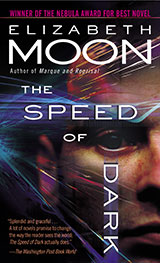
The Speed of Dark, by Elizabeth Moon

Links: Amazon BN
Overview from the author's website: "Lou is a high-functioning autistic adult who has made a good life for himself and is, he thinks, content. But a new manager in the pharmaceutical firm for which he works decides to put pressure on the unit that employs autistic persons. Lou is pressured to undergo an experimental treatment that might "cure" the autism he doesn't think needs curing, or risk losing his job--and certainly the accommodations the company has put in place for its autistic employees."
This book had me hooked by page 2. The author did such a wonderful job of bringing me, the reader, into the head of Lou and letting me see the world through his eyes. The majority of the novel is written in the first-person, present tense, which in this book helps me better understand Lou's point of view. Lou's perspective is not that of a normal protagonist, as it is highly affected by his autism. I can't personally vouch for the accuracy of Moon's portrayal of the autistic perception, but in her acknowledgements she recognizes the help of several autistic individuals, including her own teenage child.
I think part of this book's draw is that it gives readers a chance to see their ordinary world from a fresh perspective. The setting is the near future, around 2040. No drastic changes have taken place, so it's a very relatable setting, if slightly more advanced technologically. Some of the things we take for granted or do without thinking completely baffle Lou, particularly social cues. For example, Lou is constantly bothered by the fact that "normal" people refuse to say what they really mean, choosing rather to couch their real desires in complex phrasing that he has taken great pains to learn how to decipher. Body language and facial expressions are also mysteries which lead Lou to almost believe normal people can read each others' minds.
The title comes from Lou's concern over how one might measure the speed of dark. Dark always outruns light, so its speed must be faster than that of light. He considers the generally accepted fact that dark is merely the absence of light, but reasons dark itself must have substance. He compares light to knowledge, thereby equating dark with ignorance. It is true that some ignorance is merely the absence of knowledge, but occasionally one encounters willful ignorance, meaning it has substance because it refuses to yield to light. Lou concludes there must also be substantial dark, then, and that substance must have a speed, which is faster than the speed of light.
Many of the reviews for this book claimed reading it would change the way I see the world. To some extent, they were correct. More than anything, I have learned to better appreciate those labeled as "disabled," either mentally or physically, by society. They are often capable of much more than we give them credit for, and if we take the time to learn from them, I think we would frequently be surprised. We all can benefit from a little mind stretching every now and then, and this book delivers that.
Tuesday, March 26, 2013
Introduction & Overview
Welcome to Ex Libris Nathani, a book review blog maintained by Nathan (me). I hope you enjoy perusing my reviews. Before you do, however, I invite you to read this introduction, as it illustrates my motivation for creating such a resource.
I read a lot of books, be they novels, biographies, etc. Friends often ask me for literary recommendations and opinions, and I try as best I can to describe a book with enough detail to adequately represent it, yet still avoid those pesky spoilers, the bane of readers everywhere. I decided to create this blog to give me a chance to organize my thoughts in writing so that when I am asked my opinion, I can deliver it well. At the same time, I can recommend this site to my friends, and they can read any review they wish.
I hope this site eventually becomes quite extensive. To search for a specific book, use the search function on the right side of the page.
I will post links at the top of each review, generally for amazon and BN, so that you can purchase the book or ebook there. I personally love the experience of visiting my local bookstore, however, and I would like to invite you to purchase your books there if possible. I have found most of my favorite books perusing the shelves at my bookstore, usually when I was there to pick up something else.
Let me also take this time to explain what this blog is not. I am not a professional critic, and this blog is a repository of my own opinions, which I freely admit are not expert. I welcome comments and invite you to share your own opinion of these books, but please be tasteful. Any comments I deem inappropriate will be removed.
As I obviously have read plenty of books before beginning this project, I have a lot of catching up to do. Please be patient, I will try to get to them as soon as possible.
Again, welcome to Ex Libris Nathani. I hope your visit enriches your life and motivates you to read more books.
Subscribe to:
Comments (Atom)