Links: Amazon BN Indie Bound
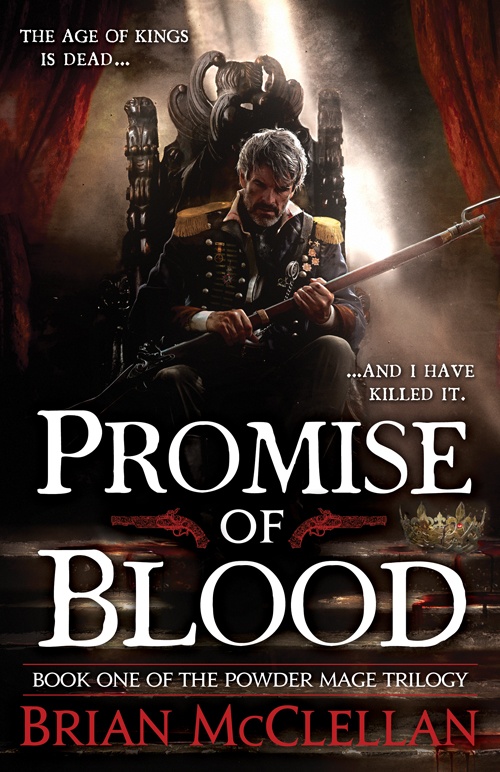
As the cover indicates, Promise of Blood is the first of the Powder Mage Trilogy, and it is the debut novel from author Brian McClellan. This book is part of a growing fantasy sub-genre called flintlock fantasy, expertly explained here. "Magic and muskets" is the name of the game, particularly in this story.
Magic users in Promise of Blood are generally divided into three broad categories. There are the Privileged, who are traditional sorcerers, wielding elemental magic of fire, earth, air, water, and aether to great effect. With the development of gunpowder, a threat to the primacy of Privileged has arisen in the form of the Powder Mages. These magic users may snort gunpowder to enter a "powder trance", enhancing reflexes, focus, etc. Powder Mages can also ignite gunpowder mentally and use the released energy in many interesting ways, including to divert bullets in flight to increase accuracy or deflect attacks. The final group are the Knacked, who are born with a greatly enhanced passive ability, such as possessing an eidetic memory or having no need for sleep. Knacked also possess the Third Eye, or the ability to sense magical auras. I could describe these groups in greater detail, but I'll leave that to Mr. McClellan.
The setting for this story is the kingdom of Adro, one of nine kingdoms established by a group of powerful beings or gods millennia ago. The book opens with a military coup overthrowing the corrupt king of Adro, whose frivolous spending had him on the brink of essentially selling his kingdom to his neighbor the Kez to pay off his debts. The coup is led by Field Marshal Tamas, a Powder Mage, who rounds up and executes the king and his nobles for their poor handling of the kingdom. He replaces them with a ruling council of his co-conspirators, who begin to manage affairs of state. This regicide does not sit well with Adro's neighbors, particularly Kez, who quickly begin to cause trouble for the new government.
Woven into all of the politics and war is a mystery concerning something called "Kresimir's promise." The king's Royal Cabal of Privileged are killed defending their sovereign, and each repeats the same phrase with his/her dying breath: "Don't break Kresimir's promise." Kresimir was the leader of those powerful beings that set up the kingdoms, beings which many (including Tamas) believe to be myths. Tamas hires a Knacked named Adamat to investigate this mystery, which threatens grave repercussions as it unravels.
I hope I've whetted your interest for the story, because it is presented marvelously. As it unfolds, it of course becomes more and more complicated, but this complexity makes sense and never gets out of hand, in my opinion. McClellan's characters are deep, with interesting backstories and complex motivations driving their decisions. The story includes plenty of action to spice things up, with everything from pitched battles down to individual fights, both magical and mundane. The plot twists were the right mix of reasonable and unexpected; I think I guessed maybe 50% of them.
I'm excited to read more of this trilogy. The second novel, The Crimson Campaign, is available now, and so are many short stories and novellas set in the same world. All are available at the author's website, brianmcclellan.com. Happy reading!
Welcome to Ex Libris Nathani. If this is your first time visiting the site, please read the introduction
Thursday, August 21, 2014
Sunday, June 22, 2014
Dead Harvest, by Chris F. Holm
Links: Amazon BN
This is the first book of a trilogy called The Collector, narrated by the titular protagonist Sam Thornton. As a Collector, Sam's job is to collect the souls of bad folk for their eternal damnation in Hell. It's a miserable job, but it's not like he chose it. Sam was given the job as a result of bad choices made in life, culminating in a shoddy deal with a demon. So now he's stuck in this job for the foreseeable future, which could be a long, long time: Sam doesn't do this work in his own body, he possesses the bodies of others so as to blend in with the local populace as he hunts down the souls he is sent to collect. In summary, Sam Thornton is Hell's repo man.
Of course, just hunting down bad guys isn't much of a setting for conflict, so the story must take an unexpected turn. Sam is sent to collect the soul of a young woman who brutally murdered her entire family, but when he tries to do so, he discovers that she is innocent of the crime, no matter how convincing the evidence is. So now Sam has to figure out who set up this woman, apparently well enough that both Heaven and Hell were duped. And of course, he must do it while being chased down by demons and angels intent on enforcing the collection order.
This was a fun thriller of a book, with frantic chases, surprise reveals, and a fair amount of divine and arcane intervention. I love the dynamic character that is Sam Thornton: not superhuman, always making the right choices, but not fatally flawed, always bumbling through and somehow succeeding. Sam makes mistakes, but he also hatches clever plans, both on and off screen, that slowly but surely guide us to the thrilling conclusion and final reveal, one that was hinted at but was still a surprise twist.
I would like to especially note the engaging tone of the narration. Sam Thornton recounts the story as if to a close friend, long after the events have transpired. The conversational tone gives the story a natural flow and rhythm, just from little lines like "Don't look at me like that; you weren't there." or "If I had known then what I do now, I would have..." If you're the type that talks to characters, warning them of impending dangers, etc., you'll like this book; the character talks back.
If you're a fan of mysteries that are solvable by the reader from the evidence given in the story (read: not Sherlock Holmes), sometimes even before the characters, but not always, this is a book worth investigating. At times, I felt confident of how the story would play out, only to be proven completely wrong; other times, I correctly guessed at least the next step. Sam Thornton is a witty, engaging character, and he kept me interested. I highly recommend this book, and hope you'll take the time to discover it for yourself.
This is the first book of a trilogy called The Collector, narrated by the titular protagonist Sam Thornton. As a Collector, Sam's job is to collect the souls of bad folk for their eternal damnation in Hell. It's a miserable job, but it's not like he chose it. Sam was given the job as a result of bad choices made in life, culminating in a shoddy deal with a demon. So now he's stuck in this job for the foreseeable future, which could be a long, long time: Sam doesn't do this work in his own body, he possesses the bodies of others so as to blend in with the local populace as he hunts down the souls he is sent to collect. In summary, Sam Thornton is Hell's repo man.
Of course, just hunting down bad guys isn't much of a setting for conflict, so the story must take an unexpected turn. Sam is sent to collect the soul of a young woman who brutally murdered her entire family, but when he tries to do so, he discovers that she is innocent of the crime, no matter how convincing the evidence is. So now Sam has to figure out who set up this woman, apparently well enough that both Heaven and Hell were duped. And of course, he must do it while being chased down by demons and angels intent on enforcing the collection order.
This was a fun thriller of a book, with frantic chases, surprise reveals, and a fair amount of divine and arcane intervention. I love the dynamic character that is Sam Thornton: not superhuman, always making the right choices, but not fatally flawed, always bumbling through and somehow succeeding. Sam makes mistakes, but he also hatches clever plans, both on and off screen, that slowly but surely guide us to the thrilling conclusion and final reveal, one that was hinted at but was still a surprise twist.
I would like to especially note the engaging tone of the narration. Sam Thornton recounts the story as if to a close friend, long after the events have transpired. The conversational tone gives the story a natural flow and rhythm, just from little lines like "Don't look at me like that; you weren't there." or "If I had known then what I do now, I would have..." If you're the type that talks to characters, warning them of impending dangers, etc., you'll like this book; the character talks back.
If you're a fan of mysteries that are solvable by the reader from the evidence given in the story (read: not Sherlock Holmes), sometimes even before the characters, but not always, this is a book worth investigating. At times, I felt confident of how the story would play out, only to be proven completely wrong; other times, I correctly guessed at least the next step. Sam Thornton is a witty, engaging character, and he kept me interested. I highly recommend this book, and hope you'll take the time to discover it for yourself.
Saturday, May 31, 2014
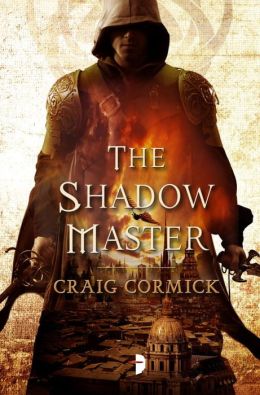
The Shadow Master, by Craig Cormick
From the author's website:
In a land riven with plague, inside the infamous Walled City, two families vie for control: the Medicis with their genius inventor Leonardo; the Lorraines with Galileo, the most brilliant alchemist of his generation.
And when two star-crossed lovers, one from either house, threaten the status quo, a third, shadowy power – one that forever seems a step ahead of all of the familial warring – plots and schemes, and bides its time, ready for the moment to attack...
Assassination; ancient, impossible machines; torture and infamy – just another typical day in paradise.
For some reason, the description has it reversed: Galileo works for the Medicis, Leonardo for the Lorraines. Not a big deal; the important part is that these two men of science are competing to show off their genius. At the same time, they are peaceful men, and so they work to pacify the warring Houses with mechanical toys and wonders while avoiding building war machines that could devastate the city, the last refuge against the plague. The people in the Walled City are protected from the plague by a spice wine supplied by the competing families, which of course makes it even harder for others to challenge their authority.
Despite the "star-crossed lovers", this story is definitely not just another Romeo and Juliet knockoff. Galileo and Leonardo's inventions give the book a sort of Renaissance-era steampunk feel, and every new gadget introduced is a treat to read about. The author includes just the right amount of description, in my opinion: enough to help me understand the scene or the device, but not so much that by the time he gets back to the action I've forgotten what's going on. It's surprising how difficult this balance is to achieve, and this book does it masterfully.
From the author's website, it appears The Shadow Master is Cormick's first novel for adult readers. This book is an incredible debut, and I highly recommend it.
Tuesday, May 13, 2014
Empire State, by Adam Christopher
Links: Amazon BN
This book bills itself as superhero-noir, which is an accurate categorization, if a bit heavier on the noir. The primary setting is the Empire State, a shadowy alternate version of New York City where Prohibition has continued much longer than it did in our world. Rad Bradley, a private eye, is hired to solve the mysterious disappearance of a client's lover. The investigation eventually leads Rad to learn about a mysterious alternate reality: ours.
The Empire State is similar to NYC, except it's completely isolated; no one who leaves the island ever returns. A war is going on with a mysterious belligerent known only as the Enemy to citizens of the Empire State, and Wartime restrictions are in effect in the city. As the story develops, more about the Empire State becomes clear, but I will leave that to you to discover.
I admit that this book isn't for everyone. It has a very convoluted plot that honestly only became clear in the final chapter of the book, which is a little later than some people like. Up until the very end of the book, I really didn't know for sure who the good and the bad guys were. The mystery kept me interested, but I can see how it might be frustrating for some. I quite enjoyed struggling to add up the clues I had to get a clear picture, and I did piece together some of it, but not all.
The superhero aspect is there, but it's a bit understated to be one of the defining characteristics of the book. I enjoyed the superheroes, but I feel like I was led to expect something more from the way this book was advertised on the back cover. Basically, what I got was a good story, but not the story I was expecting.
All in all, this book is an intriguing mystery novel, which some science-fiction elements to give the story a unique setting. There is also action at times, which livens things up. I enjoyed the book, and I haven't really seen much about it online, so I hope this review inspires some interested readers to take a look.
This book bills itself as superhero-noir, which is an accurate categorization, if a bit heavier on the noir. The primary setting is the Empire State, a shadowy alternate version of New York City where Prohibition has continued much longer than it did in our world. Rad Bradley, a private eye, is hired to solve the mysterious disappearance of a client's lover. The investigation eventually leads Rad to learn about a mysterious alternate reality: ours.
The Empire State is similar to NYC, except it's completely isolated; no one who leaves the island ever returns. A war is going on with a mysterious belligerent known only as the Enemy to citizens of the Empire State, and Wartime restrictions are in effect in the city. As the story develops, more about the Empire State becomes clear, but I will leave that to you to discover.
I admit that this book isn't for everyone. It has a very convoluted plot that honestly only became clear in the final chapter of the book, which is a little later than some people like. Up until the very end of the book, I really didn't know for sure who the good and the bad guys were. The mystery kept me interested, but I can see how it might be frustrating for some. I quite enjoyed struggling to add up the clues I had to get a clear picture, and I did piece together some of it, but not all.
The superhero aspect is there, but it's a bit understated to be one of the defining characteristics of the book. I enjoyed the superheroes, but I feel like I was led to expect something more from the way this book was advertised on the back cover. Basically, what I got was a good story, but not the story I was expecting.
All in all, this book is an intriguing mystery novel, which some science-fiction elements to give the story a unique setting. There is also action at times, which livens things up. I enjoyed the book, and I haven't really seen much about it online, so I hope this review inspires some interested readers to take a look.
Blades of Winter, by G. T. Almasi
Links: Amazon BN
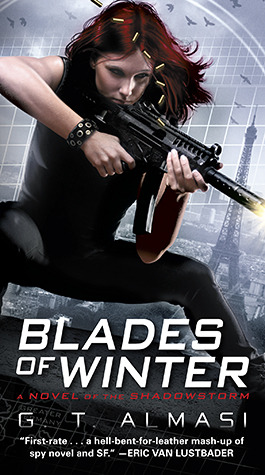
The saying goes that you shouldn't judge a book by its cover, but in the case of Blades of Winter, the book delivered exactly what was promised by the cover: loads of action. Our hero is one Alix Nico, a young agent in the US government's Extreme Operations (ExOps) agency. In a word, she is a superspy, but superspies have been institutionalized in this alternative history. But Alix is motivated to rise through the ranks, especially because of her father's death in service to the same agency. It wouldn't be a story without conflict, however, and there's plenty of it in this book, both within ExOps and without.
In this story, Germany wasn't conquered in WWII, and Chiang Kai-shek and his nationalists maintained control of China. This has led to a four-way Cold War between the superpowers of the US, Russia, Greater Germany, and China. As the stakes of the dangerous spy game (known as the Shadowstorm, which gives the series its name) rose, so did the technology which aids the combatants. Modifications and enhancements to the human body are standard issue for the agents of ExOps and their foreign counterparts, collectively known as Levels. Missions are ranked by the same system: a Level 12 job is meant to be accomplished by a Level 12 operative. Our hero Alix has such enhancements as night and infrared vision, enhanced joints and bones for extra speed, and an internal drug delivery system that pumps her with synthetic adrenaline for combat. She also has her father's old gun, which connects to her other internal hardware via a connection on her palm, giving her not a heads-up display, but an Eyes-Up display for identifying and dispatching targets.
I hope I've given enough of a taste to intrigue you without giving the whole story away. Superspy vs. superspy is a wonderful setup for intense action, and this book delivers marvelously. There are also tense scenes of infiltration, where Alix needs to cool her hot head and try not to be noticed, which gives the story excellent dynamics. I personally love the setting, being a bit of a history buff. Exposition for the setting takes place mostly between chapters in the form of news articles and the like, which serve to develop a picture of the world of the Shadowstorm.
Like all good stories, this one delivers quite a few impressive twists, but not so many that it ties the plot up in Gordian knots. I enjoyed being kept guessing at points, but there was also the satisfaction that comes with correctly identifying on occasion how our hero will escape this latest mess. Both chaos and predictability work well in Blades of Winter and deliver a satisfying action thriller.
The saying goes that you shouldn't judge a book by its cover, but in the case of Blades of Winter, the book delivered exactly what was promised by the cover: loads of action. Our hero is one Alix Nico, a young agent in the US government's Extreme Operations (ExOps) agency. In a word, she is a superspy, but superspies have been institutionalized in this alternative history. But Alix is motivated to rise through the ranks, especially because of her father's death in service to the same agency. It wouldn't be a story without conflict, however, and there's plenty of it in this book, both within ExOps and without.
In this story, Germany wasn't conquered in WWII, and Chiang Kai-shek and his nationalists maintained control of China. This has led to a four-way Cold War between the superpowers of the US, Russia, Greater Germany, and China. As the stakes of the dangerous spy game (known as the Shadowstorm, which gives the series its name) rose, so did the technology which aids the combatants. Modifications and enhancements to the human body are standard issue for the agents of ExOps and their foreign counterparts, collectively known as Levels. Missions are ranked by the same system: a Level 12 job is meant to be accomplished by a Level 12 operative. Our hero Alix has such enhancements as night and infrared vision, enhanced joints and bones for extra speed, and an internal drug delivery system that pumps her with synthetic adrenaline for combat. She also has her father's old gun, which connects to her other internal hardware via a connection on her palm, giving her not a heads-up display, but an Eyes-Up display for identifying and dispatching targets.
I hope I've given enough of a taste to intrigue you without giving the whole story away. Superspy vs. superspy is a wonderful setup for intense action, and this book delivers marvelously. There are also tense scenes of infiltration, where Alix needs to cool her hot head and try not to be noticed, which gives the story excellent dynamics. I personally love the setting, being a bit of a history buff. Exposition for the setting takes place mostly between chapters in the form of news articles and the like, which serve to develop a picture of the world of the Shadowstorm.
Like all good stories, this one delivers quite a few impressive twists, but not so many that it ties the plot up in Gordian knots. I enjoyed being kept guessing at points, but there was also the satisfaction that comes with correctly identifying on occasion how our hero will escape this latest mess. Both chaos and predictability work well in Blades of Winter and deliver a satisfying action thriller.
Monday, May 12, 2014
Prince of Thorns, by Mark Lawrence
Links: Amazon BN
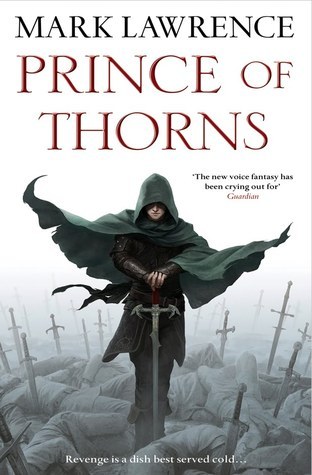
I found this book while browsing the shelves of my local bookstore, and I'm glad I did. The protagonist and narrator is Prince Jorg Ancrath, who from a young age must deal with some pretty harrowing experiences. At the age of nine, his mother was brutally killed while he looked on helplessly from a thorn bush where their attackers left him for dead. This trauma eventually led him to leave home and seek out his own fortune among the mercenaries and cutthroats of society. As the story opens, Jorg has, through his strange mix of brutality and charm, won the allegiance of a small band of ruffians who join him in terrorizing the countryside. Oh, and he's only thirteen years old. His ambitions lead him back to the country of his birth, intending to challenge his father and claim the throne that is his birthright.
Several factors work synergically to make this an exceptional story. First is Jorg himself. His traumatic experiences harden him and serve to fuel his drive to rule and have control. yet his random flashes of humanity serve to make him a dynamic and unpredictable character, and his development is something I look forward to watching unfold in the rest of the series. Like Walter White on Breaking Bad, I find that even though I don't particularly like Jorg, I enjoy rooting for him and watching him overcome challenges.
Another facet of the book that fascinated me is the setting, which is a developing mystery. The series is called The Broken Empire, which has been split into about a hundred warring territories, all ruled by leaders with dubious claims to the throne of the emperor. Vestiges of a distant past remain in the religion of the people, as well as in the roads and various items left by a culture known as the Builders, which were clearly more advanced than the feudal society of the Broken Empire. Small clues are revealed at various times to flesh out the setting, but leaving enough of a mystery that I was hooked on learning more.
There are elements of fantasy in this story, like necromancy and sorcery, but the intrigue and action is what really sold me on this book. If you want a TL;DR, one of the reviews I read called the book "Game of Thrones on speed", which is an apt if incomplete description. I recommend that you read this book and discover it for yourself.
I found this book while browsing the shelves of my local bookstore, and I'm glad I did. The protagonist and narrator is Prince Jorg Ancrath, who from a young age must deal with some pretty harrowing experiences. At the age of nine, his mother was brutally killed while he looked on helplessly from a thorn bush where their attackers left him for dead. This trauma eventually led him to leave home and seek out his own fortune among the mercenaries and cutthroats of society. As the story opens, Jorg has, through his strange mix of brutality and charm, won the allegiance of a small band of ruffians who join him in terrorizing the countryside. Oh, and he's only thirteen years old. His ambitions lead him back to the country of his birth, intending to challenge his father and claim the throne that is his birthright.
Several factors work synergically to make this an exceptional story. First is Jorg himself. His traumatic experiences harden him and serve to fuel his drive to rule and have control. yet his random flashes of humanity serve to make him a dynamic and unpredictable character, and his development is something I look forward to watching unfold in the rest of the series. Like Walter White on Breaking Bad, I find that even though I don't particularly like Jorg, I enjoy rooting for him and watching him overcome challenges.
Another facet of the book that fascinated me is the setting, which is a developing mystery. The series is called The Broken Empire, which has been split into about a hundred warring territories, all ruled by leaders with dubious claims to the throne of the emperor. Vestiges of a distant past remain in the religion of the people, as well as in the roads and various items left by a culture known as the Builders, which were clearly more advanced than the feudal society of the Broken Empire. Small clues are revealed at various times to flesh out the setting, but leaving enough of a mystery that I was hooked on learning more.
There are elements of fantasy in this story, like necromancy and sorcery, but the intrigue and action is what really sold me on this book. If you want a TL;DR, one of the reviews I read called the book "Game of Thrones on speed", which is an apt if incomplete description. I recommend that you read this book and discover it for yourself.
Sunday, May 11, 2014
Shield and Crocus, by Michael R. Underwood
Links: Amazon BN
Author Michael Underwood was kind enough to get me an advance reader copy (ARC) of this upcoming book, and I'm most grateful I had the opportunity to take it in. I was quite impressed by what I found.
The setting of this story is the city of Audec-Hal, the home of several races of people. Each race has a unique "birthright", abilities granted by virtue of their heritage (e.g. telekinesis, seeing the emotional connections between people, extreme speed, etc.). For the last fifty years, Audec-Hal and its citizens have suffered under the oppression of five tyrants who have divided the city among themselves and share an uneasy peace. These oligarchs employ both magic and technology to maintain their power base, and the combinations of the two are quite interesting.
Hope is not lost however; it struggles on in the form of the Shields of Audec-Hal, a small band of insurgents who fight against the tyrants by means of what is essentially guerrilla warfare: mostly small strikes, but a few larger ones against the tyrants' strongholds as well. The Shields are a small but versatile group who use their birthrights effectively to gain advantages in combat. Their leader is the First Sentinel, an old alchemist who remembers the time before the rise of the tyrants, when Audec-Hal was ruled by a democratically-elected Senate. As the story opens, the tyrants have agreed to a summit to formally divide the city and consolidate their power, something the Shields have to do whatever it takes to stop.
I'll let you read the rest of the story yourself, but I hope I've piqued your curiosity. The story is told from the points of view of the various Shields, with interludes giving the perspective of some of the tyrants. The shifting viewpoint serves to give an impressively full picture of the world and the situation as it develops, yet it leaves enough mystery to keep the reader interested.
Magic and technology traditionally belong to separate genres, namely fantasy and science fiction, respectively. A lot of attempts to mix the two in literature have failed in various ways, though the steampunk genre and its popularity show there is an interest in continuing the effort. This book is definitely not steampunk; it's something all its own. Where else would you find an android working with a sorceror, battling an alchemist/artificer?
In summary, this book is a wonderful adventure, with a depth and development of characters that is tough to find in modern literature. I look forward to more in this series.
Author Michael Underwood was kind enough to get me an advance reader copy (ARC) of this upcoming book, and I'm most grateful I had the opportunity to take it in. I was quite impressed by what I found.
The setting of this story is the city of Audec-Hal, the home of several races of people. Each race has a unique "birthright", abilities granted by virtue of their heritage (e.g. telekinesis, seeing the emotional connections between people, extreme speed, etc.). For the last fifty years, Audec-Hal and its citizens have suffered under the oppression of five tyrants who have divided the city among themselves and share an uneasy peace. These oligarchs employ both magic and technology to maintain their power base, and the combinations of the two are quite interesting.
Hope is not lost however; it struggles on in the form of the Shields of Audec-Hal, a small band of insurgents who fight against the tyrants by means of what is essentially guerrilla warfare: mostly small strikes, but a few larger ones against the tyrants' strongholds as well. The Shields are a small but versatile group who use their birthrights effectively to gain advantages in combat. Their leader is the First Sentinel, an old alchemist who remembers the time before the rise of the tyrants, when Audec-Hal was ruled by a democratically-elected Senate. As the story opens, the tyrants have agreed to a summit to formally divide the city and consolidate their power, something the Shields have to do whatever it takes to stop.
I'll let you read the rest of the story yourself, but I hope I've piqued your curiosity. The story is told from the points of view of the various Shields, with interludes giving the perspective of some of the tyrants. The shifting viewpoint serves to give an impressively full picture of the world and the situation as it develops, yet it leaves enough mystery to keep the reader interested.
Magic and technology traditionally belong to separate genres, namely fantasy and science fiction, respectively. A lot of attempts to mix the two in literature have failed in various ways, though the steampunk genre and its popularity show there is an interest in continuing the effort. This book is definitely not steampunk; it's something all its own. Where else would you find an android working with a sorceror, battling an alchemist/artificer?
In summary, this book is a wonderful adventure, with a depth and development of characters that is tough to find in modern literature. I look forward to more in this series.
Subscribe to:
Comments (Atom)